

A North Dakota jury on Wednesday awarded hundreds of millions of dollars in damages to the Texas-based pipeline company Energy Transfer, which had sued Greenpeace over its role in protests nearly a decade ago against its Dakota Access Pipeline.
The verdict was a major blow to the storied environmental organization. Greenpeace had maintained that it played only a minor part in demonstrations led by the Standing Rock Sioux Tribe. It had portrayed the lawsuit as an attempt to stifle oil-industry critics, but a jury apparently disagreed.
The nine-person jury in the Morton County courthouse in Mandan, N.D., about 45 minutes north of where the protests took place, returned the verdict after roughly two days of deliberating.
Energy Transfer’s co-founder and board chairman, Kelcy Warren, an ally and donor to President Trump, had been outspoken in his criticism of the protesters and had the last word during plaintiffs’ closing arguments on Monday, when his lawyers played comments he made in a video deposition for the jurors.
“We’ve got to stand up for ourselves,” Mr. Warren said, arguing that protesters had created “a total false narrative” about his company. “It was time to fight back.”
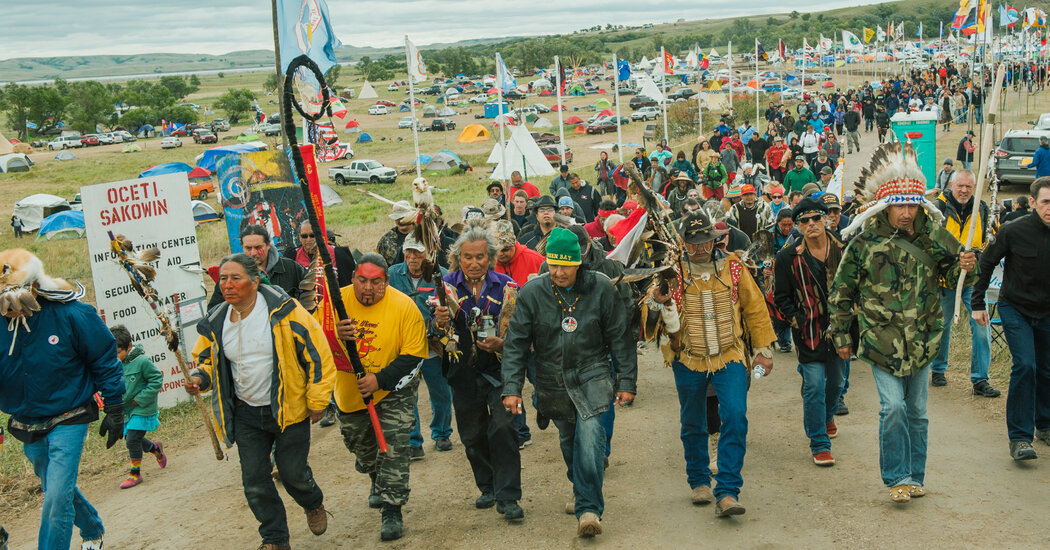
Energy Transfer is one of the largest pipeline companies in the country. The protests over its construction of the Dakota Access Pipeline drew national attention and thousands of people to monthslong encampments in 2016 and 2017.
The demonstrators gathered on and around the Standing Rock Sioux Reservation, arguing that the pipeline cut through sacred land and could endanger the water supply. The Standing Rock tribe sued to stop the project, and members of other tribes, environmentalists and celebrities were among the many who flocked to the rural area, including two figures who are now members of Mr. Trump’s cabinet: Robert F. Kennedy Jr. and Tulsi Gabbard.
But the protests erupted into acts of vandalism and violence at some points, alienating people in the surrounding community in the Bismarck-Mandan area.
Greenpeace has argued that the lawsuit was a threat to First Amendment rights, brought by a deep-pocketed plaintiff, that carries dangerous implications for organizations that speak out about a broad range of issues. Greenpeace has called the lawsuit a “Strategic Lawsuit Against Public Participation,” or SLAPP suit, the term for cases meant to hinder free speech by raising the risk of expensive legal battles. Many states have laws that make it difficult to pursue such cases, though not North Dakota.
Trey Cox of the firm Gibson Dunn & Crutcher, the lead lawyer for Energy Transfer, laced into Greenpeace during closing arguments on Monday. The company accused Greenpeace of funding and supporting attacks and protests that delayed the pipeline’s construction, raised costs and harmed Energy Transfer’s reputation.
Jurors, Mr. Cox said, would have the “privilege” of telling the group that its actions were “unacceptable to the American way.” He displayed costs incurred that tallied up to about $340 million, and asked for punitive damages on top of that.
“Greenpeace took a small, disorganized, local issue and exploited it to shut down the Dakota Access Pipeline and promote its own selfish agenda,” he said. “They thought they’d never get caught.”
The 1,172-mile underground pipeline has been operating since 2017, but is awaiting final permits for a small section where it crosses federal territory underneath Lake Oahe on the Missouri River, near Standing Rock. The tribe is still trying to shut down the pipeline, in a different lawsuit.
Lawyers for Greenpeace called the case against the group a “ridiculous” attempt to pin blame on it for everything that happened during months of raucous protests, including federal-government delays in issuing permits. Greenpeace has said that a $300 million judgment could force it to shut down its operations in the United States.
Three Greenpeace entities were named in the lawsuit: Greenpeace Inc., Greenpeace Fund, and Greenpeace International. Greenpeace Inc. is the arm of the group that organizes public campaigns and protests. It is based in Washington, D.C., as is Greenpeace Fund, which raises money and gives out grants.
The third entity named in the lawsuit, Greenpeace International, based in Amsterdam, is the coordinating body for 25 independent Greenpeace groups around the world.
It was principally the actions of Greenpeace Inc. that were at the heart of the trial, which began Feb. 24. They included training people in protest tactics, dispatching its “Rolling Sunlight” solar-panel truck to provide power, and offering funds and other supplies. Greenpeace International maintained that its only involvement was signing a letter to banks expressing opposition to the pipeline, a document that was signed by hundreds and that had been drafted by a Dutch organization. Greenpeace Fund said it had no involvement.
Mr. Cox alleged that all three entities were, in fact, working together as “one enterprise.”
Greenpeace International has also countersued Energy Transfer in the Netherlands, invoking a new European Union directive against SLAPP suits, as well as Dutch law.
Everett Jack Jr., of the firm Davis Wright Tremaine, was the lead lawyer for the Greenpeace Inc., and a study in contrasts with Mr. Cox. Both men wore dark suits and red ties for their closing arguments. But their demeanors were polar opposites.
Mr. Cox was energetic, indignant, even wheeling out a cart stacked with boxes of evidence during his rebuttal to argue that he had proved his case. Mr. Jack was calm and measured, recounting the chronology of how the protests developed to make the case that they had swelled well before Greenpeace got involved.
Given the months of disruptions caused locally by the protests, the jury pool in the area was widely expected to favor Energy Transfer.
Among the observers in the courtroom were a group of lawyers calling themselves the Trial Monitoring Committee, who criticized the court for denying a Greenpeace petition to move the trial to the bigger city of Fargo, which was not as affected by the protests. The group included Martin Garbus, a prominent First Amendment lawyer, and Steven Donziger, who is well-known for his yearslong legal battle with Chevron over pollution in Ecuador.
The committee took issue with the number of jurors with ties to the oil industry or who expressed negative views of protests during jury selection. But Suja A. Thomas, an expert on juries and law professor at the University of Illinois, said the precedent in North Dakota courts was not to use “blanket disqualifications of jurors just because they might have some kind of interest,” whether it’s financial or based on experience or opinion.
Rather, the judge has to determine whether each individual juror can be impartial. “There can be interest; they have to determine whether the interest is significant enough such that the person cannot be fair,” Ms. Thomas said.
Natali Segovia is the executive director of Water Protector Legal Collective, an Indigenous- led legal and advocacy nonprofit that grew out of the Standing Rock protests. Ms. Segovia, who is also a member of the trial monitoring committee, said her organization was involved with about 800 criminal cases that resulted from the protests. The vast majority have been dismissed, she said.
What had gotten lost during the Greenpeace trial, she said, was the concern about water that had spurred so much protest. She saw a larger dynamic at play. “At its core, it’s a proxy war against Indigenous sovereignty using an international environmental organization,” she said.
