Close Menu
    What's Hot

    What you should know before investing in NPS in 2026?

    January 13, 2026

    New Proposed Legislation Would Let Self-Driving Cars Operate in New York State

    January 13, 2026

    December 2025: Oversupply Fears Grow as Higher Crude Oil Stocks are expected

    January 12, 2026
    Facebook X (Twitter) Instagram
    Facebook X (Twitter) Instagram
    Trend Alerts – Stay Ahead of the Trends!
    Subscribe
    • Home
    • Trending

      New Proposed Legislation Would Let Self-Driving Cars Operate in New York State

      January 13, 2026

      10 Best Pet Cameras (2026), Tested With Our Pets

      January 12, 2026

      Bluesound Pulse Cinema Review: A Pretty Sonos Alternative

      January 12, 2026

      16 Best Heat Protectant Sprays for Wet and Dry Hair (2026)

      January 11, 2026

      Fujifilm X-E5 Mirrorless Camera Review: Compact Color Science in a Retro Package

      January 11, 2026
    • Worldwide

      December 2025: Oversupply Fears Grow as Higher Crude Oil Stocks are expected

      January 12, 2026

      Rhine Freight Market: Low Water Levels Drive Rate Increases into the New Year

      January 8, 2026

      Displaced Palestinians in Egypt Await Reopening of Gaza Border

      January 7, 2026

      ARA Freight Market: Post-Holiday Reset Brings Strong Rebound in Activity and Firming Rates

      January 7, 2026

      How We Tracked Abuses in the Russian Army

      December 31, 2025
    • Finance

      What you should know before investing in NPS in 2026?

      January 13, 2026

      Risk of investing in digital gold

      January 12, 2026

      Looking to invest in high growth property? Here’s four key factors that you should know about

      January 11, 2026

      IDFC FIRST Wealth Credit Card review 2026

      January 10, 2026

      Should you invest in Portfolio Management Services (PMS)?

      January 9, 2026
    • Business

      A Guide to Increasing Your Workplace Productivity with AI

      January 11, 2026

      How Managers Are Using AI to Make Smarter Decisions

      January 10, 2026

      The Top 10 HBS Online Videos You Loved This Year

      January 10, 2026

      5 New Year’s Resolution Ideas to Boost Your Career

      January 9, 2026

      How to Choose the Right AI Course for Your Career Goals

      January 9, 2026
    • News

      World’s Most Unbelievable Events That No One Expected

      March 16, 2025

      Biggest Space Discoveries That Went Viral This Year

      March 16, 2025

      AI Just Did This! The Most Shocking AI Development Yet

      March 16, 2025

      Mind-Blowing Tech Innovations That Went Viral in 2025

      March 16, 2025

      Top 10 Viral Moments That Broke the Internet in 2025

      March 16, 2025
    Trend Alerts – Stay Ahead of the Trends!
    Home»Finance»Where Congress’s Cuts Threaten Access to PBS and NPR
    Finance

    Where Congress’s Cuts Threaten Access to PBS and NPR

    Elon MarkBy Elon MarkJuly 18, 2025No Comments4 Mins Read
    Facebook Twitter LinkedIn Telegram Pinterest Tumblr Reddit WhatsApp Email
    Share
    Facebook Twitter LinkedIn Pinterest Email


    President Trump’s proposal to eliminate federal funding for public broadcasters threatens scores of radio and TV stations across the United States that air PBS and NPR programs.

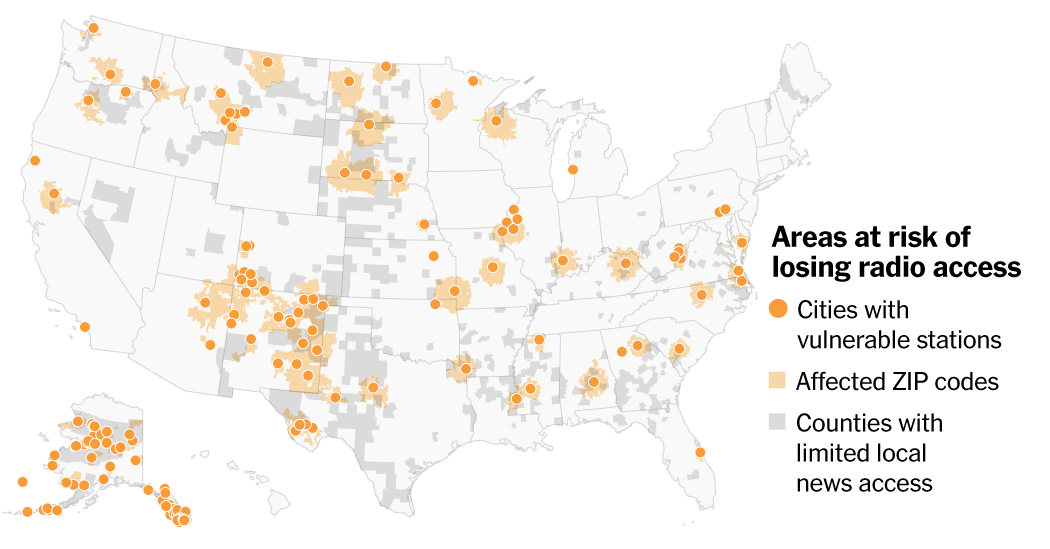
    Areas at risk of losing public radio and television access

    Radio

    Cities with vulnerable stations

    Counties with limited local news access

    Television

    Cities with vulnerable stations

    Counties with limited local news access

    Sources: Analysis of at-risk organizations and their stations’ locations by Public Media Company, based on data from the Corporation for Public Broadcasting. Data on news access by county is from the Medill Local News Initiative.

    Note: Dots represent cities where there are stations operated by at-risk organizations.

    The New York Times

    Early Friday, the House gave final approval to a measure that would eliminate $1.1 billion in funding for the Corporation for Public Broadcasting, the company that funds NPR, PBS and stations in major cities and far-flung towns like Unalakleet, Alaska, and Pendleton, Ore. The measure will now be sent to President Trump, who has pushed for the cuts, for his signature.

    The cuts are a time bomb for the public media system. The Corporation for Public Broadcasting has disbursed funding for stations through September. After that, more than 100 combined TV and radio stations that serve millions of Americans in rural pockets of the country will be at risk of going dark, according to an analysis from Public Media Company, an advisory firm.

    But the troubles could run deeper than that, said Tim Isgitt, the organization’s chief executive. The sudden and dramatic reduction in funding will result in a pool of fewer stations to buy programming and solicit donations, potentially creating a “doom loop” with dire consequences for the rest of the system.

    “Failing stations will create a cascade effect in this highly connected and interdependent system, impacting content producers and leading to the potential collapse of additional distressed stations in other areas of the country,” Mr. Isgitt said.

    An analysis by Public Media Company identified 78 public radio organizations and 37 TV organizations that were at risk of going dark as a result of the cuts. In some cases those organizations operate multiple stations, allowing them to reach even greater populations.

    The stations rely on grants from the Corporation for Public Broadcasting and other federal funding for at least 30 percent of their budgets, and some of them serve counties with limited access to local news.

    Republicans have been trying to defund public media for decades, arguing that news coverage on NPR has a liberal bias and that taxpayers should not be required to support coverage they disagree with. Those attempts have repeatedly failed, with lawmakers unwilling to choke off funding to local stations that serve their constituents.

    This week was different. In a Senate vote that mostly broke down along party lines, Republicans clawed back funding from public media organizations in their own states, with some exceptions.

    In some states with stations at risk of going dark, such as Mississippi, both senators voted to defund public media. But there was some Republican support in some of the most-affected states, such as Alaska, where Sen. Lisa Murkowski cast a “no” vote, and Maine, where Sen. Susan Collins also opposed the measure. In those states, the combined federal funding for the stations as a proportion of their total budgets is relatively high.

    The average proportion of station funding from federal sources, by state

    States are grouped by how many of their senators voted to approve the funding clawbacks.

    States where both senators voted to defund

    Avg. across
    TV stations
    Avg. across
    radio stations
    Miss. 18% 30%
    Kan. 32% 12%
    Wyo. 34% 10%
    Ark. 27% 15%
    S.D. 20% 22%
    Tenn. 32% 8%
    Idaho 18% 19%
    Ind. 26% 11%
    N.D. 16% 15%
    Neb. 19% 10%
    W.Va. 19% 10%
    Mont. 9% 19%
    Texas 20% 8%
    Mo. 18% 9%
    Ohio 20% 6%
    Ala. 12% 13%
    N.C. 14% 10%
    Okla. 14% 10%
    Utah 12% 11%
    Ky. 11% 11%
    Iowa 11% 10%
    La. 12% 9%
    Fla. 12% 8%
    S.C. 13% 6%

    One senator voted to defund

    Avg. across
    TV stations
    Avg. across
    Radio stations
    Alaska 41% 31%
    Pa. 14% 6%
    Wis. 11% 5%

    No senators voted to defund

    Avg. across
    TV stations
    Avg. across
    Radio stations
    Maine 35% 22%
    N.M. 24% 29%
    Md. 23% 11%
    Mich. 21% 8%
    Minn. 24% 4%
    N.H. 22% 6%
    Va. 18% 8%
    R.I. 6% 19%
    N.J. 10% 14%
    Ariz. 11% 12%
    Ill. 16% 7%
    Ore. 14% 8%
    Ga. 14% 7%
    Colo. 12% 7%
    Hawaii 14% 5%
    N.Y. 14% 5%
    Calif. 12% 6%
    Vt. 12% 6%
    Wash. 11% 7%
    Conn. 7% 6%
    Nev. 6% 7%
    Mass. 8% 4%
    Del. — 10%

    Source: Public Media Company, based on data from the Corporation for Public Broadcasting.

    Notes: States are sorted by the combined averages of the proportion of television and radio station budgets derived from federal sources. Senator Tina Smith, a Democrat from Minnesota, did not cast a vote.

    The New York Times

    The at-risk stations have a few months to figure out how to make up their financial shortfalls. Public Media Company has begun to speak with philanthropists and foundations about possible solutions.


    Source link

    Access Congresss Cuts NPR PBS Threaten
    Share. Facebook Twitter Pinterest LinkedIn Tumblr Telegram Email
    Previous ArticleICE Is Getting Unprecedented Access to Medicaid Data
    Next Article How China’s Patriotic ‘Honkers’ Became the Nation’s Elite Cyber Spies
    Elon Mark
    • Website

    Related Posts

    What you should know before investing in NPS in 2026?

    January 13, 2026

    Risk of investing in digital gold

    January 12, 2026

    Looking to invest in high growth property? Here’s four key factors that you should know about

    January 11, 2026
    Add A Comment
    Leave A Reply Cancel Reply

    Top Posts

    10 Trends From Year 2020 That Predict Business Apps Popularity

    January 20, 2021

    Shipping Lines Continue to Increase Fees, Firms Face More Difficulties

    January 15, 2021

    Qatar Airways Helps Bring Tens of Thousands of Seafarers

    January 15, 2021

    Subscribe to Updates

    Get the latest sports news from SportsSite about soccer, football and tennis.

    Advertisement
    Demo

    TrendAlerts is your go-to platform for the latest trending news, covering global events, technology, business, entertainment, and more. Stay informed with real-time updates and in-depth analysis on what’s shaping the world today! 🚀

    We're social. Connect with us:

    Facebook X (Twitter) Instagram Pinterest YouTube
    Top Insights

    Top UK Stocks to Watch: Capita Shares Rise as it Unveils

    January 15, 2021
    8.5

    Digital Euro Might Suck Away 8% of Banks’ Deposits

    January 12, 2021

    Oil Gains on OPEC Outlook That U.S. Growth Will Slow

    January 11, 2021
    Get Informed

    Subscribe to Updates

    Get the latest creative news from FooBar about art, design and business.

    © 2026 Trend Alerts. All Rights Are Reserved.
    • Home
    • Trending
    • Worldwide
    • Finance
    • Business
    • News

    Type above and press Enter to search. Press Esc to cancel.