

What if your friend said he “owned a part of a tech park in Bengaluru for just ₹10,000”? You might think your friend is joking. Forget a tech park here, how is it even possible to own a fraction of any real estate property with just a few thousand rupees?
To buy one apartment, we save for years, tying up our life savings in a single property. Also, even if one decides to venture bravely into this, the thought of shelling out crores, managing tenants, or worrying about repairs makes that dream feel like a distant fantasy. But rapid urbanisation has changed everything! Something unimaginable a decade ago became possible. So, when your friend opened his investment app and revealed something called a REIT, it turned out, he wasn’t kidding at all.
REITs bridge the gap between traditional real estate ownership and modern investing. They give retail investors like us exposure to high-value commercial properties, while offering professional management and liquidity that physical property can’t match.
Here’s what you need to know about REITs, from basic structure to their taxation.
What are Real Estate Investment Trusts (REITs)?
Real Estate Investment Trusts (REITs) are like the mutual funds of real estate. Instead of buying physical property, you buy shares in a company that owns and operates income-generating real estate. Income-generating real estate means the properties that generate regular income for the owner, typically through rent. That could mean office buildings, resorts, shopping malls, hotels, or even data centres in some cases.
Just like mutual funds, different properties are all bundled into one investment vehicle. You (a unitholder), among other investors, buy units (like shares), and the REIT uses that money to buy and manage real estate. This is more like crowdfunding real estate, but with proper rules, regulations, and structure, which we will focus on next.
What is the basic structure of REITs?
A REIT has a simplified structure with three key parties: a sponsor, a management company, and a trustee, each with a specific responsibility. All REITs must be registered with the Securities and Exchange Board of India (SEBI).
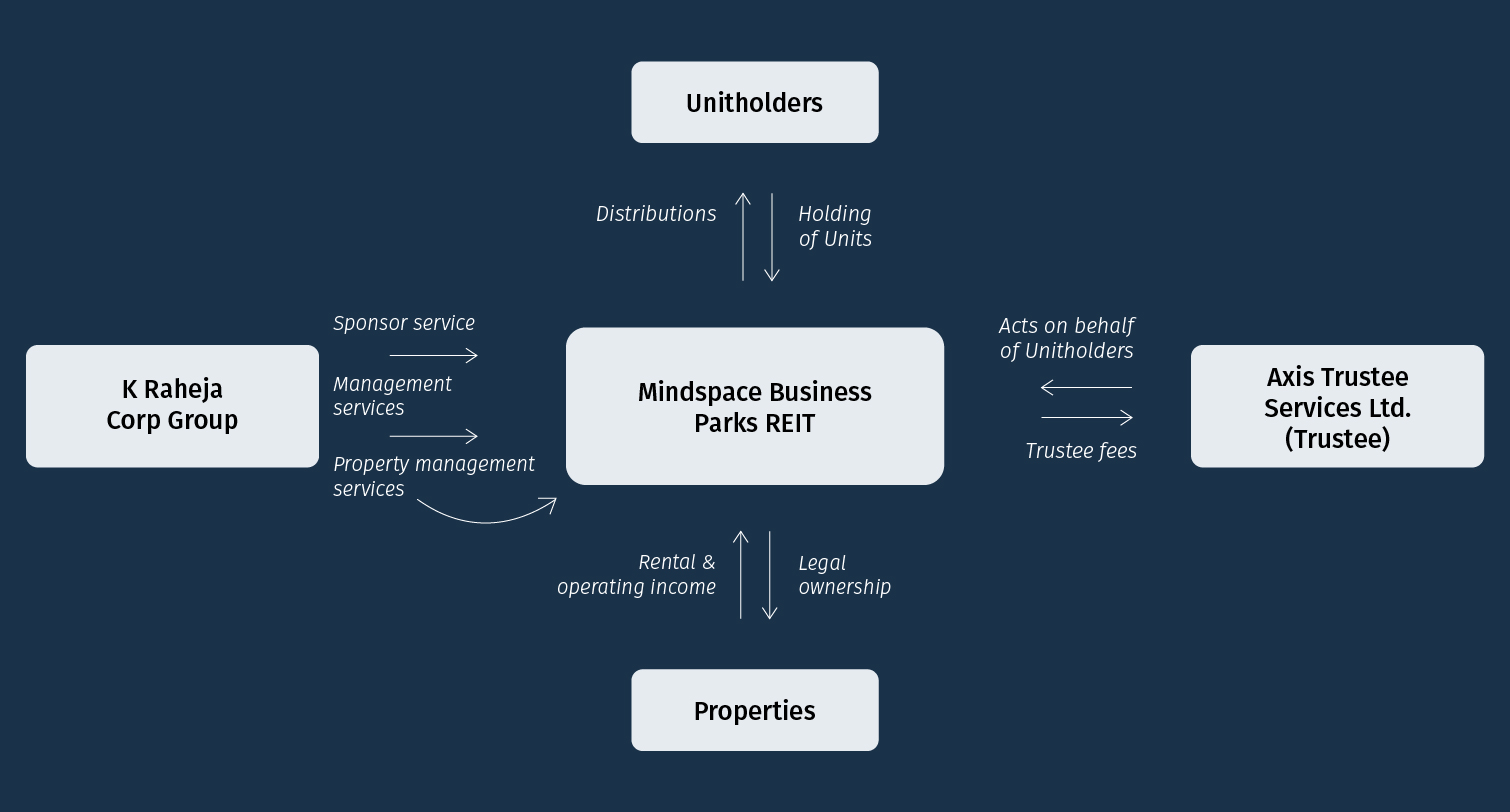
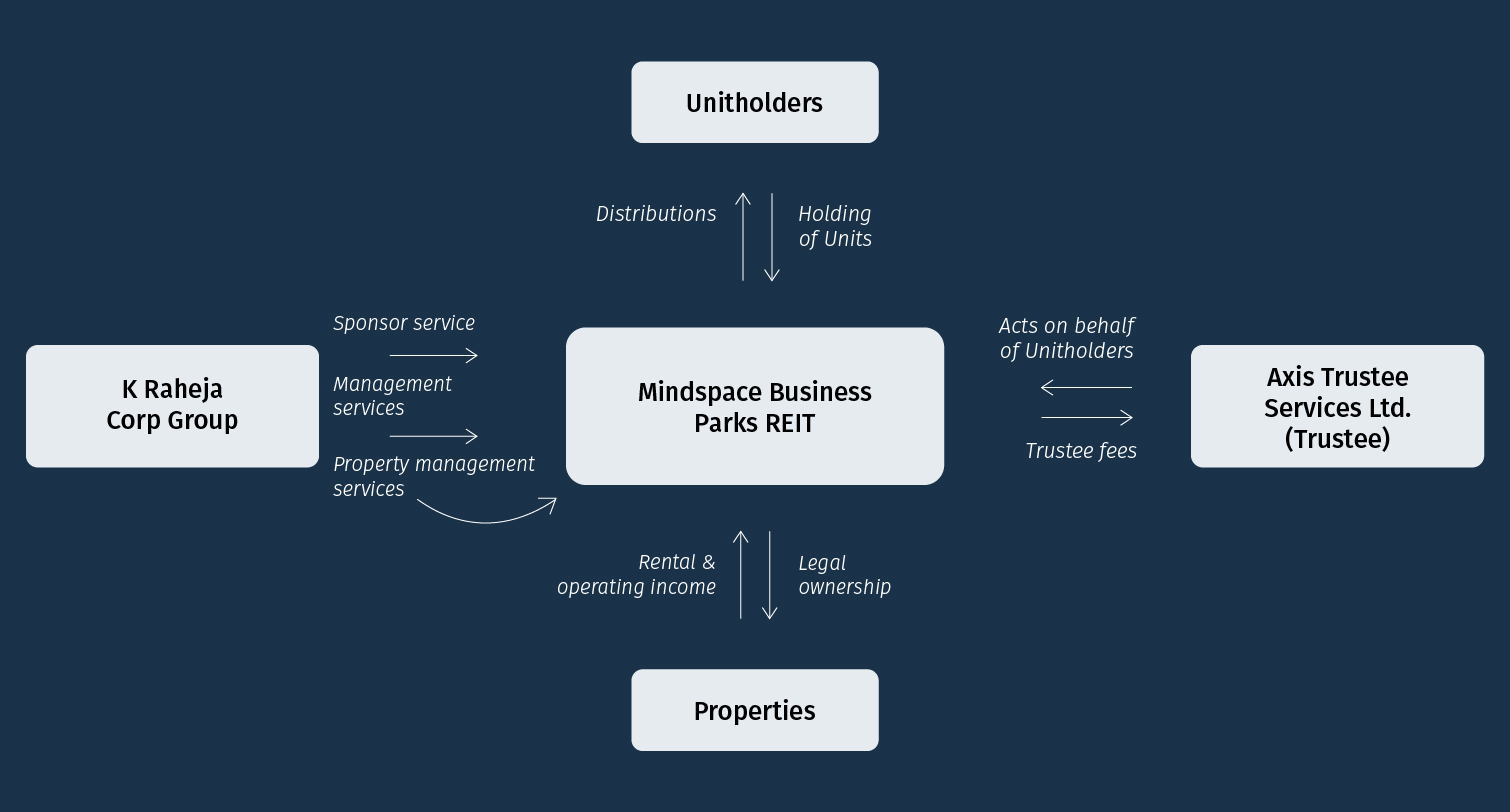
Using Mindspace Business Parks REIT as an example, let’s see how different entities work together to bring a regulated structure in REITs.
1. The sponsor
K Raheja Corp Group, the sponsor, sets up the Mindspace Business Parks REIT by transferring the commercial office parks into it. They also appoint a manager and a trustee.
2. The management company
The management company, K Raheja Corp Investment Managers Pvt. Ltd., takes charge of day-to-day operations like maintaining the assets, leasing the spaces to different companies, while focusing on what benefits the REIT.
3. The trustee
The trustee, Axis Trustee Services Limited, now holds all the assets on behalf of the unitholders, acting as a guardian and ensuring fair practices, and correct distribution of rental income to the unitholders.
The structure of REITs in India: Mindspace Business Parks REIT
The following image gives you a pictorial structural overview of Mindspace Business Parks REIT.
Its properties include Mindspace Airoli (East and West), Paradigm Mindspace Malad, Commerzone Yerwada, Commerzone Porur, Mindspace Madhapur, Mindspace Pocharam, and many more.
In some cases, REIT can own properties through Special Purpose Vehicles (SPVs), a separate legal entity that owns or operates the actual real estate properties.
REITs are like a good-souled landlord who shares rent cheques with hundreds of tenants regularly. In this way, REITs are structured to channel income directly to investors. A typical REIT owns and manages real estate, collects rent, and distributes at least 90% of its taxable income to its shareholders.
Doesn’t this sound like an attractive way to generate a steady income? But wait, let’s talk about how SEBI makes sure everything stays transparent and investor-friendly.
What are SEBI rules for REITs?
The SEBI has laid down clear rules to protect investors and ensure transparency. The main regulatory document is SEBI (Real Estate Investment Trusts) Regulations, 2014, which was last amended on September 3, 2025 to ease operations, enhance investor protection, and improve flexibility.
- REITs must invest at least 80% of their funds in completed, income-generating properties (like offices or malls), while up to 20% can be allotted to under-construction projects, financial instruments, or infrastructure facilities like power plants and waste treatment plants.
- REITs must give at least 90% of their profits to investors (unitholders) as dividends or income payouts.
- REITs must hold annual meetings for investors within set deadlines. They must also submit regular compliance and audit reports, helping investors stay informed.
- If the REIT takes on a lot of debt, it must get a credit rating from a registered agency, so investors can understand the financial risk.
These rules ensure that REITs are well-regulated investment vehicles.
Investing in REITs: How to buy REITs in India
Thanks to SEBI’s backing, investing in REITs has become easier for retail investors like us. So, how do you actually get started?
What do you need to start investing in REITs?
- A DEMAT account
- An investment app
- A few thousand rupees
How to invest in REITs
You can invest in REITs in two ways:
- Public issues (IPO or follow-on issue): When a REIT offers its units for the first time or issues additional units.
- Stock exchanges: Buying units directly from the exchanges, like National Stock Exchange (NSE) and Bombay Stock Exchange (BSE), just like shares.
Process for public issues (IPO or follow-on Issue)
- Price discovery: The price of REIT units is decided through the book-building process.
- Application and payment:
- Investors must apply through the ASBA process (Applications Supported by Blocked Amount). Since Aug 1, 2022, UPI payment (up to ₹5 lakh) is also allowed.
- You must either pay the full bid amount or allow your bank to block that amount at the time of application.
- Allotment and listing:
- Units are allotted only in demat form.
- Investors must carefully mention their Depository Participant ID, PAN, Client ID, and other details correctly.
- REIT units are listed on the stock exchange within 12 working days after the issue closes.
Currently trading REITs in India
Source: Indian REITs Association (IRA), as of March 31, 2025
*Gross asset value is the addition of the current market price of all the properties in a real estate fund, before subtracting any loans or debts.
All the above REITs are registered with SEBI.
Back to the friend’s story we mentioned earlier. He didn’t call a broker or visit real estate sites. He simply opened his investment app and bought a REIT like any other stock. Now, you might be wondering what kind of returns REITs can offer.
How to earn passive income from REITs
Your earnings from REITs come in two main ways: dividends and capital gains.
1. Dividends (Regular income)
REITs pay at least 90% of their income as dividends, quarterly-half-yearly, from the rent collected on the properties. So, if a REIT earns ₹100 crores in rental income, ₹90 crores must flow back to unitholders. It’s like you are receiving rent without even being a landlord or owning a property.
2. Capital appreciation
Over the period of time, the value of that real estate property may go up. Hence, it also increases the REIT’s unit price. So, if you sell at the right time, then that’s a profit for you.
So, while we are explaining the income-generating aspects of REITs to you, your friend’s investment is quietly collecting rent and possibly appreciating its value. That’s a fine example of passive income!
REITs offer an easy way to be in real estate.
- No EMIs.
- No property tax.
- No tenant drama.
- No liquidity headaches.
Once reserved for the ultra-wealthy, a real estate investment is now accessible to anyone with even a modest investment appetite through REITs. But wait, no money talks are complete without taxation.
How are REITs income taxed in India?
The government of India treats income from REITs differently; it may be tax-free or taxable depending on how it is structured. If it is passed on as interest or rent, it is taxed at your regular income slab, whereas the case could be different for dividends and capital gains.
Dividends taxation
Dividends distributed by REITs are generally tax-free for investors, only if REITs’ underlying SPVs have already paid corporate tax. This is to ensure there is no double taxation.
Capital gains taxation
*Indexation benefits are not available.
Interest income taxation
Interest is not taxed at the REIT level; instead, it’s taxed in the hands of investors. You will pay tax as per the applicable slab rates. 10% TDS is deducted if your annual interest income from REITs is more than ₹5,000. From FY 2025-26, this threshold will increase to ₹10,000.
Rental income taxation
The income generated through rents is taxable according to the applicable tax slab rates. A 10% TDS (tax deducted at source) is deducted on rental income.
It is always best to check with a Qualified Financial Advisor (QFA) to see how REITs fit into your personal financial plan.
Conclusion
Next time you think about real estate, remember: you don’t have to own a building to own a part of it. REITs offer a unique blend of real estate benefits without the burdens of direct ownership. With regulated frameworks and easy access via stock exchanges, they are increasingly becoming a favorite for investors seeking steady income and portfolio diversification.
