Close Menu
    What's Hot

    How the S&P 500 Stock Index Became So Skewed to Tech and A.I.

    February 27, 2026

    Lowe’s Promo Codes and Deals: Up to $300 Off Appliances

    February 27, 2026

    OpenAI Announces Major Expansion of London Office

    February 26, 2026
    Facebook X (Twitter) Instagram
    Facebook X (Twitter) Instagram
    Trend Alerts – Stay Ahead of the Trends!
    Subscribe
    • Home
    • Trending

      Lowe’s Promo Codes and Deals: Up to $300 Off Appliances

      February 27, 2026

      OpenAI Announces Major Expansion of London Office

      February 26, 2026

      Everyone Speaks Incel Now | WIRED

      February 26, 2026

      Samsung Galaxy S26, S26+, and S26 Ultra: Specs, Features, Price, Release Date

      February 25, 2026

      H&R Block Coupons and Deals: $25 Off Tax Prep in 2026

      February 25, 2026
    • Worldwide

      Rhine Freight Market: Rising Water Levels Remove Pressure, Market Turns Defensive

      February 19, 2026

      ARA Freight Market: IE Week Dampens Demand as Rates Drift Lower

      February 18, 2026

      Rhine Freight Market: Improving Water Levels Shift the Balance Toward Softer Rates

      February 12, 2026

      ARA Freight Market: Higher Deal Count Fails to Halt Gradual Rate Softening

      February 11, 2026

      January 2026: A Volatile Start to the Year as Geopolitics Collide with Oversupply Risks

      February 6, 2026
    • Finance

      How the S&P 500 Stock Index Became So Skewed to Tech and A.I.

      February 27, 2026

      Bank not cutting your home loan rate? Should you consider loan refinancing?

      February 25, 2026

      Finance charge in credit card explained

      February 24, 2026

      How it works and why it can be dangerous

      February 23, 2026

      Bank not cutting your home loan rate? Should you refinance?

      February 22, 2026
    • Business

      5 Steps for Building Strategic Partnerships in Your Negotiations

      February 20, 2026

      How CLIMB Helped Emmanuel Aniemeke Apply Vital Business Lessons

      February 19, 2026

      How to List Certifications & Credentials on Your Resume

      February 14, 2026

      How to Build Trust in Workplace Relationships

      February 11, 2026

      5 Soft Skills to Put on a Resume & How to Prove Them

      February 10, 2026
    • News

      World’s Most Unbelievable Events That No One Expected

      March 16, 2025

      Biggest Space Discoveries That Went Viral This Year

      March 16, 2025

      AI Just Did This! The Most Shocking AI Development Yet

      March 16, 2025

      Mind-Blowing Tech Innovations That Went Viral in 2025

      March 16, 2025

      Top 10 Viral Moments That Broke the Internet in 2025

      March 16, 2025
    Trend Alerts – Stay Ahead of the Trends!
    Home»Finance»How the S&P 500 Stock Index Became So Skewed to Tech and A.I.
    Finance

    How the S&P 500 Stock Index Became So Skewed to Tech and A.I.

    Elon MarkBy Elon MarkFebruary 27, 2026No Comments5 Mins Read
    Facebook Twitter LinkedIn Telegram Pinterest Tumblr Reddit WhatsApp Email
    Share
    Facebook Twitter LinkedIn Pinterest Email


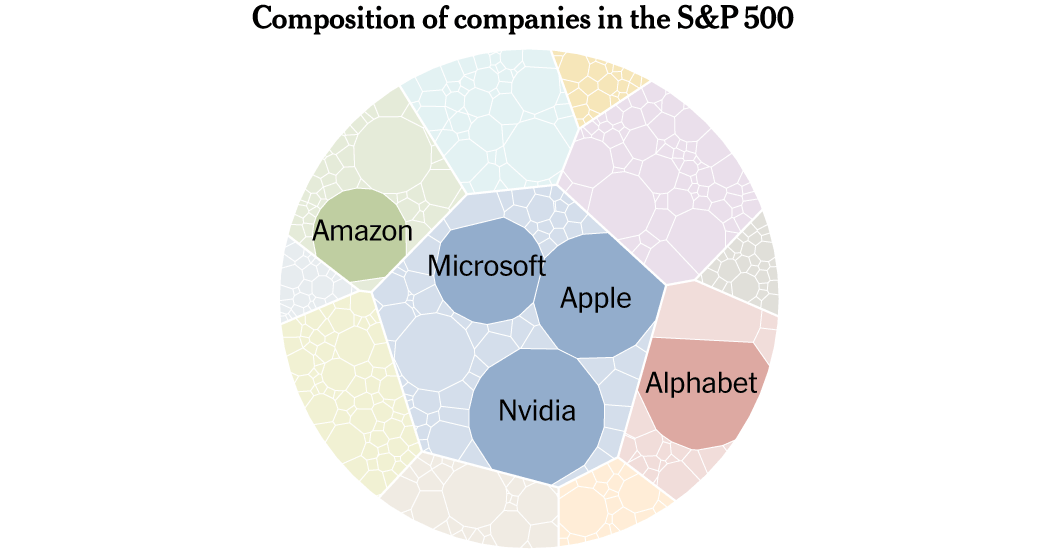
    Nvidia, the chipmaker that became the world’s most valuable public company two years ago, was alone worth more than $4.75 trillion as of Thursday morning. Its value, or market capitalization, is more than double the combined worth of all the companies in the energy sector, including oil giants like Exxon Mobil and Chevron.

    The chipmaker’s market cap has swelled so much recently, it is now 20 percent greater than the sum of all of the companies in the materials, utilities and real estate sectors combined.

    What unifies these giant tech companies is artificial intelligence. Nvidia makes the hardware that powers it; Microsoft, Apple and others have been making big bets on products that people can use in their everyday lives.

    But as worries grow over lavish spending on A.I., as well as the technology’s potential to disrupt large swaths of the economy, the outsize influence that these companies exert over markets has raised alarms. They can mask underlying risks in other parts of the index. And if a handful of these giants falter, it could mean widespread damage to investors’ portfolios and retirement funds in ways that could ripple more broadly across the economy.

    The dynamic has drawn comparisons to past crises, notably the dot-com bubble. Tech companies also made up a large share of the stock index then — though not as much as today, and many were not nearly as profitable, if they made money at all.

    How the current moment compares with past pre-crisis moments

    To understand how abnormal and worrisome this moment might be, The New York Times analyzed data from S&P Dow Jones Indices that compiled the market values of the companies in the S&P 500 in December 1999 and August 2007. Each date was chosen roughly three months before a downturn to capture the weighted breakdown of the index before crises fully took hold and values fell.

    The companies that make up the index have periodically cycled in and out, and the sectors were reclassified over the last two decades. But even after factoring in those changes, the picture that emerges is a market that is becoming increasingly one-sided.

    In December 1999, the tech sector made up 26 percent of the total.

    In August 2007, just before the Great Recession, it was only 14 percent.

    Today, tech is worth a third of the market, as other vital sectors, such as energy and those that include manufacturing, have shrunk.

    Since then, the huge growth of the internet, social media and other technologies propelled the economy.

    Now, never has so much of the market been concentrated in so few companies. The top 10 make up almost 40 percent of the S&P 500.

    How much of the S&P 500 is occupied by the top 10 companies

    With greater concentration of wealth comes greater risk. When so much money has accumulated in just a handful of companies, stock trading can be more volatile and susceptible to large swings. One day after Nvidia posted a huge profit for its most recent quarter, its stock price paradoxically fell by 5.5 percent. So far in 2026, more than a fifth of the stocks in the S&P 500 have moved by 20 percent or more. Companies and industries that are seen as particularly prone to disruption by A.I. have been hard hit.

    The volatility can be compounded as everyone reorients their businesses around A.I, or in response to it.

    The artificial intelligence boom has touched every corner of the economy. As data centers proliferate to support massive computation, the utilities sector has seen huge growth, fueled by the energy demands of the grid. In 2025, companies like NextEra and Exelon saw their valuations surge.

    The industrials sector, too, has undergone a notable shift. General Electric was its undisputed heavyweight in 1999 and 2007, but the recent explosion in data center construction has evened out growth in the sector. Caterpillar, which is often associated with construction, has seen a spike in sales of its turbines and power-generation equipment, which are used in data centers.

    One large difference between the big tech companies now and their counterparts during the dot-com boom is that many now earn money. A lot of the well-known names in the late 1990s, including Pets.com, had soaring valuations and little revenue, which meant that when the bubble popped, many companies quickly collapsed.

    Nvidia, Apple, Alphabet and others generate hundreds of billions of dollars in revenue each year.

    And many of the biggest players in artificial intelligence these days are private companies. OpenAI, Anthropic and SpaceX are expected to go public later this year, which could further tilt the market dynamic toward tech and A.I.

    Methodology

    Sector values reflect the GICS code classification system of companies in the S&P 500. As changes to the GICS system took place from 1999 to now, The New York Times reclassified all companies in the index in 1999 and 2007 with current sector values. All monetary figures from 1999 and 2007 have been adjusted for inflation.


    Source link

    A.I Index Skewed Stock Tech
    Share. Facebook Twitter Pinterest LinkedIn Tumblr Telegram Email
    Previous ArticleLowe’s Promo Codes and Deals: Up to $300 Off Appliances
    Elon Mark
    • Website

    Related Posts

    Bank not cutting your home loan rate? Should you consider loan refinancing?

    February 25, 2026

    Finance charge in credit card explained

    February 24, 2026

    How it works and why it can be dangerous

    February 23, 2026
    Add A Comment
    Leave A Reply Cancel Reply

    Top Posts

    10 Trends From Year 2020 That Predict Business Apps Popularity

    January 20, 2021

    Shipping Lines Continue to Increase Fees, Firms Face More Difficulties

    January 15, 2021

    Qatar Airways Helps Bring Tens of Thousands of Seafarers

    January 15, 2021

    Subscribe to Updates

    Get the latest sports news from SportsSite about soccer, football and tennis.

    Advertisement
    Demo

    TrendAlerts is your go-to platform for the latest trending news, covering global events, technology, business, entertainment, and more. Stay informed with real-time updates and in-depth analysis on what’s shaping the world today! 🚀

    We're social. Connect with us:

    Facebook X (Twitter) Instagram Pinterest YouTube
    Top Insights

    Top UK Stocks to Watch: Capita Shares Rise as it Unveils

    January 15, 2021
    8.5

    Digital Euro Might Suck Away 8% of Banks’ Deposits

    January 12, 2021

    Oil Gains on OPEC Outlook That U.S. Growth Will Slow

    January 11, 2021
    Get Informed

    Subscribe to Updates

    Get the latest creative news from FooBar about art, design and business.

    © 2026 Trend Alerts. All Rights Are Reserved.
    • Home
    • Trending
    • Worldwide
    • Finance
    • Business
    • News

    Type above and press Enter to search. Press Esc to cancel.