

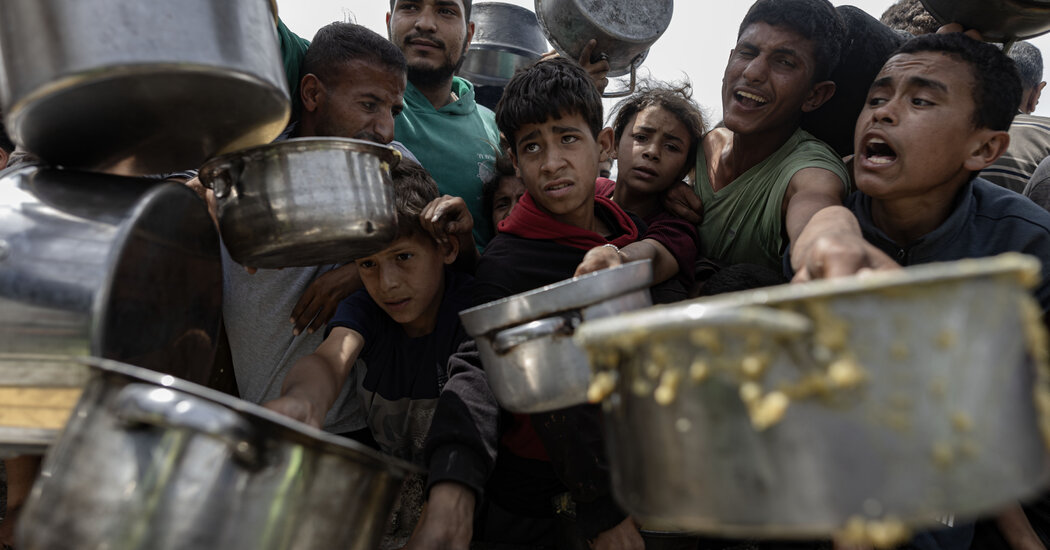
It has been more than 60 days since Israel ordered a halt to all humanitarian aid entering Gaza — no food, fuel or even medicine.
As the phone calls pour in, Muneer Alboursh, the director general of Gaza’s health ministry, is running out of answers.
The longer Israel’s total siege of the enclave grinds on, the more doctors call to ask where they can find medicine to keep patients alive. Some patients call him up themselves — people with treatable heart problems or kidney failure — to ask: If there is no medicine, what else can they try?
“There’s no advice I can give them,” he said. “In most cases, those patients die.”
Israel says it will not relent until Hamas releases the hostages it still holds after a two-month cease-fire collapsed in March. It has argued that its blockade is lawful, and that Gaza still has enough available provisions.
But humanitarian groups and European officials accuse Israel of using aid as a “political tool” — and warn that the total blockade violates international law.
The severity of the siege means it now affects nearly every part of the lives of the roughly two million people trapped inside Gaza, compounding the struggles of a population that has lived for nearly two decades under the partial blockade imposed by Israel and backed by Egypt after Hamas seized control of the enclave in 2007.
As supplies of clean water, food and medicine dwindle, preventable diseases and illnesses are surging — and so is the likelihood of dying from them, doctors say.
Aid groups are raising the alarm in increasingly drastic messages, warning that the humanitarian support for Gazans is “on the verge of total collapse.”
“To the Israeli authorities, and those who can still reason with them, we say again: Lift this brutal blockade,” said Tom Fletcher, the U.N. humanitarian chief. He added: “To the civilians left unprotected, no apology can suffice. But I am truly sorry that we are unable to move the international community to prevent this injustice.”
Every morning, Gazans brace for a daylong struggle to obtain life’s necessities.
Bakeries have been forced to close. Late last month, the U.N. agency that assists Palestinian refugees said its flour supplies had run out, and the World Food Program said it had delivered the last of its supplies to food kitchens.
The only food available to many Gazans — particularly those among the 90 percent of the population that is displaced and mostly living in tents — comes from local charity kitchens, some of which have been looted as the hunger crisis deepens.
Ahmed Mohsen, 30, a construction worker, spends around two hours a day standing in line to fill his pot. On the day he spoke to The New York Times, all he received was plain rice.
Prices of the food still available in markets cited by locals are astronomical for an impoverished population largely unable to work amid the war: Canned vegetables are now around $8, 10 times as much as before the siege; and a sack flour that cost around $5 before is now around $300.
“Imagine you haven’t tasted meat, a boiled egg or even an apple in months,” Mr. Mohsen said.
Ahmed al-Nems, 32, a grocer displaced to Gaza City, lives on the occasional can of food and a stockpile of flour, lentils and kidney beans that his family hopes to stretch for several more weeks by eating a single meal per day. His mother cooks on a fire fed with torn-up shoes because there is no fuel.
“We eat once a day, at noon, and that’s it,” he said. “I feel like I can’t breathe when I see my brothers and sisters are still hungry.”
A U.N.-backed monitoring system for malnutrition, the Integrated Food Security Phase Classification, recently began a new review to determine whether conditions in Gaza amount to famine.
Already, the United Nations said, 91 percent of the population analyzed — just under the roughly two million believed to be in Gaza — is estimated to be facing “food insecurity,” with most enduring “emergency” or “catastrophic” levels.
The Israeli authority overseeing aid access to Gaza has repeatedly argued that this U.N.-backed reporting contains “factual and methodological flaws, some of them serious.”
In recent days, local journalists and Palestinian health authorities have uploaded several videos of sickly, skeletal children.
Malnutrition has had knockdown effects on the entire medical system.
Burn victims from Israeli bombardment are unable to obtain enough food for skin grafts to heal.
At Al-Shifa Hospital, the head of nephrology, Dr. Ghazi al-Yazji, helplessly watches patients wither.
“Dialysis patients need a balanced diet, but everyone is surviving mainly on canned foods,” he said.
Medication shortages mean he has cut his patients’ weekly dialysis sessions to two times a week from three, and shortened them. The rationing will gradually cause toxins to build up in their bodies, he said.
But he has no choice: “Otherwise patients would go without dialysis altogether, which would be fatal.”
Medications to treat blood pressure and diabetes are gradually decreasing, he added, while cardiac catheters are nearly depleted, and anyone needing them is likely to die.
Gaza’s health ministry says its warehouses are now out of 37 percent of “essential medicines.”
The Israeli authorities say the United Nations, aid groups and private businesses brought in huge stocks of supplies during the cease-fire that should ensure that the population can still meet its needs. It accuses Hamas of hoarding supplies and depriving its own population.
But aid groups contacted by The Times insist that some supplies — particularly produce, some medicines, cooking gas and the type of fuel used by ambulances — have simply run out.
And while some warehouses remain stocked in Gaza, they often simply cannot reach them.
Since Israel’s new bombardment after the cease-fire collapsed, it has declared more and more evacuation and no-go zones, forcing some 420,000 Gazans to flee yet again and blocking access to around 70 percent of the enclave, according to U.N. estimates.
Gaining access to warehouses in these areas requires coordination with the Israeli Army, which several aid workers said was a long, bureaucratic process, with permission often denied.
The Israeli authorities responsible for responsible for aid access in Gaza did not comment on specific questions about the aid situation in Gaza and referred the questions to the prime minister’s office. The prime minister’s office did not comment.
The blockade has even affected production of clean water, said Paula Navarro, the water and sanitation coordinator for Doctors Without Borders in Gaza.
Generators at Gaza’s main desalination plant are producing potable water at only 10 percent of its usual capacity, she said, after Israel also cut off electricity in the blockade.
Now even that production is at risk, with fuel stores inaccessible.
“The estimation is that 90 percent of the fuel that is in storage in Gaza today is inaccessible due to evacuation orders,” she said.
Most Gazans cannot retrieve clean water anyway, she said, because of extensive damage to water pipelines and long waits at water trucks.
Many instead turn to boreholes with unsanitary water or use Israeli water pipes that reach Gaza but have been damaged in the war. Using unclean water has prompted a spike in jaundice, diarrhea and scabies cases, Ms. Navarro said.
“Drinkable water has become increasingly rare, so people have adapted,” said Ahmed al-Ijla, a father of three who, like most others in Gaza City, now drinks salty water. “The effect of the blockade is visible now on people’s faces — everyone is pale. Their nerves are shot.”
Dr. al-Yazji, at Al-Shifa Hospital, says he still tries to advise his patients on how to maintain a healthy lifestyle. But every day, it seems more pointless.
“Without urgent intervention and resumption of aid, we will lose more patients,” he said. “We are facing a catastrophic situation.”
Iyad Abuheweila contributed reporting from Istanbul, and Farnaz Fassihi from New York.
