

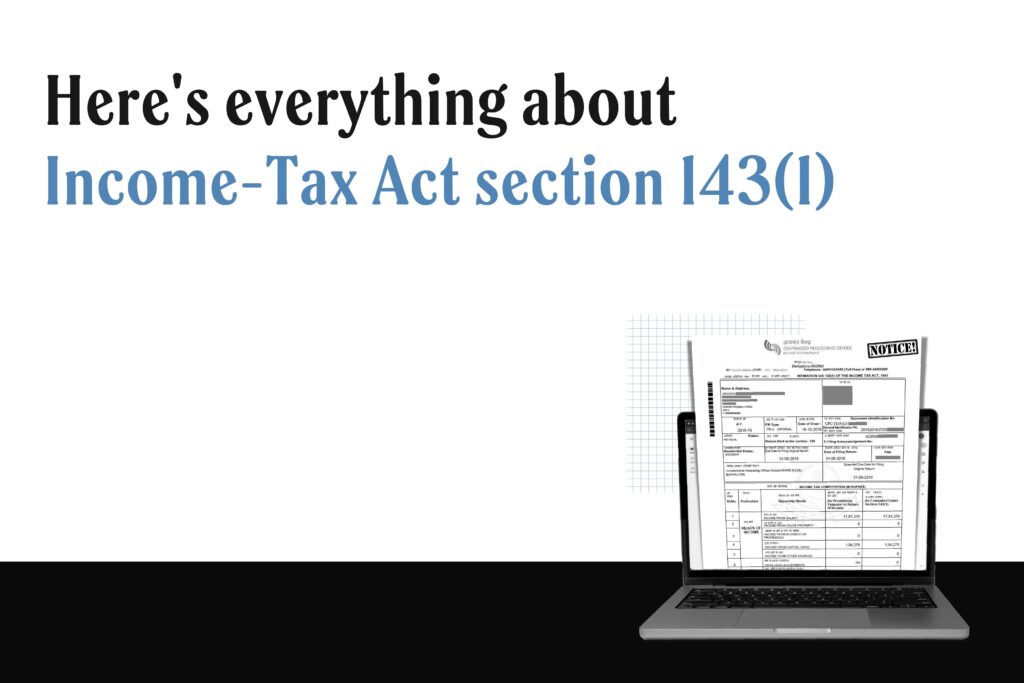
Have you ever received an email or SMS from the Income Tax Department that says your “ITR has been processed under Section 143(1)”?
If yes, you’re not alone. Almost every taxpayer who files their return receives this notice – and yet, very few actually know what it means.
In simple words, Section 143(1) is the first step after you file your Income Tax Return (ITR). It’s a preliminary check done by the Income Tax Department to verify whether the details you’ve entered in your return match with the data they have in their system.
Let’s break this down step-by-step, so even if you have zero background in taxation, you’ll know exactly what happens after you file your ITR – and how to respond, if needed.
What is section 143(1) of the Income-Tax Act?
Section 143(1) of the Income-tax Act, 1961, deals with the processing of income tax returns that you file.
When you file your ITR, it doesn’t mean your job is done immediately. The Income Tax Department runs a computerised check – to ensure there are no mistakes or mismatches. This is called “intimation under Section 143(1)”.
So, think of it like a soft verification or a computer-generated summary sheet of your return.
It compares:
- What you declared in your ITR, and
- What the department’s records show (for example, as per Form 26AS, AIS, TIS, etc.)
Why is section 143(1) important?
This step is crucial because it confirms whether your return is accepted as filed, or if there are any discrepancies that need your attention.
You might get:
- A refund if you paid more tax than required,
- A demand notice if the department thinks you owe more tax, or
- A no difference / no refund intimation, which simply means – all good, your return matches!
What does the Income-Tax department check under 143(1)?
Under Section 143(1), the department does a mathematical and factual check. It doesn’t conduct a full-fledged scrutiny or audit – that happens under Section 143(2).
Here’s what’s verified:
- Arithmetical errors in the return (e.g., you added something wrong).
- Internal inconsistencies, like a mismatch between income and deductions.
- Tax computation mistakes, such as wrong tax rate applied.
- Mismatch between ITR and Form 26AS / AIS / TIS (e.g., TDS claimed not matching the data available with the department).
- Disallowance of deductions or exemptions that exceed statutory limits (for example, claiming ₹2.5 lakh under Section 80C instead of ₹1.5 lakh).
- Set-off of losses wrongly claimed.
- Advance tax / TDS / TCS credits cross-checked with actual records.
All these checks are automated – no human is sitting behind your return. It’s done by the CPC (Centralised Processing Centre) in Bengaluru.
In such cases you should also consider consulting a Qualified Financial Advisor as they can help navigate though such discrepancies, ensure accurate filings, and align tax strategies.
What happens after the verification?
After this automated processing, the department sends you an intimation under Section 143(1).
This document summarises three columns:
| Particulars | As per Return filed by You | As per Department |
|---|---|---|
| Total Income | ₹8,00,000 | ₹8,50,000 |
| Tax Payable | ₹52,000 | ₹62,000 |
Depending on this difference, one of three outcomes arises:
- No change – everything matches, and your ITR is accepted.
- Refund – if you paid excess tax, the refund will be credited to your bank account with interest @ 6% p.a.
- Demand – if the department finds that tax is short-paid, it will raise a demand notice for the balance amount.
How to download your 143(1) intimation
You’ll receive an email and SMS from the Income Tax Department when your ITR is processed.
The subject line usually reads:
“Intimation under Section 143(1) of the Income Tax Act for PAN XXXXXXXX and Assessment Year YYYY-YY.”
You can also download it manually:
- Log in to https://www.incometax.gov.in
- Go to: e-File → Income Tax Return → View Filed Returns
- Click on the ‘View Details’ link against your return.
- Under the “Acknowledgement and ITR-V / Intimation Order” tab, click Download Intimation u/s 143(1).
It is usually sent as a password-protected PDF, where your password is your PAN (in lowercase) followed by your date of birth in DDMMYYYY format.
(Example: For PAN ABCDE1234F and DOB 15-08-1989, the password is abcde1234f15081989.)
It is in 2 languages, first in Hindi & thereafter in English.
What should you do after receiving the intimation?
Don’t panic if you get an email like this – it doesn’t mean there’s a problem. Follow these steps:
Step 1: Read it carefully
Open the PDF and go through the “Comparison Table” showing Returned Income vs Processed Income.
Step 2: Check for differences
If both columns match, your return is successfully processed. No further action is required.
Step 3: If there’s a mismatch
If the processed income or tax liability differs from what you filed:
- Cross-check your Form 26AS and AIS/TIS for any unreported income or missed TDS.
- Verify deductions or exemptions you may have over-claimed.
- Sometimes, the mismatch could be due to rounding errors.
Step 4: Respond if a “demand” is raised
If the intimation shows “Amount Payable”, you must verify the reason for the difference.
- If the demand is correct, pay the amount using Challan 280.
- If you disagree, you can submit an online response and request for re-processing of Return or by submitting a rectification request (explained below) through the Income Tax Portal.
Step 5: Track your refund (if applicable)
If a refund is due, it is processed automatically to your pre-validated bank account linked with PAN.
Make sure your account is verified on the portal to avoid refund failures.
In case, the Bank Account is closed, ensure you update the Income Tax Portal and submit a Refund Re-issue request.
Time limit for issuing an intimation
The Income Tax Department has 9 months from the end of the financial year in which you filed your return to issue the intimation.
Example:
If you filed your ITR for FY 2024-25 (AY 2025-26) on 31st July 2025, the intimation under Section 143(1) can be sent up to 31st December 2026.
If you don’t receive any intimation within this period, it is deemed that your ITR has been accepted as filed.
Difference between Section 143(1) and 143(2)
| Basis | Section 143(1) | Section 143(2) |
|---|---|---|
| Nature of check | Preliminary, automated check | Detailed scrutiny by officer |
| Objective | To verify arithmetic or factual mistakes | To ensure correct declaration of income |
| Conducted by | CPC (computerised) | Assessing Officer/ Assessment Unit (Faceless) |
| Requires taxpayer response? | Only if there’s a mismatch/demand | Always requires representation or response |
| Time limit to issue notice | Within 9 months | Within 3 months from end of financial year in which return is filed |
So, Section 143(1) is like a health check, while Section 143(2) is a full-body investigation.
Common reasons for differences under 143(1)
Here are a few common reasons taxpayers receive a mismatch or demand:
- Wrong PAN of employer entered – TDS not reflected.
- Mismatch in interest income as per Form 26AS vs. Income Tax Return.
- Not reporting income from two employers.
- Bank interest (Savings/ Fixed Deposit) not disclosed.
- Delay in filing leading to loss carry-forward being disallowed.
Most of these are minor and can be easily fixed by filing a rectification request.
What if you disagree with the intimation?
If you believe the intimation is incorrect, don’t worry. You can file a Rectification under Section 154 online.
Steps:
- Log in to the portal → go to Services → Rectification → New Request.
- Choose “Reprocess the return” or “Return data correction (online)” option.
- Upload correct information and submit.
This ensures your issue is re-evaluated without needing to visit any income tax office physically.
Conclusion
Section 143(1) may look intimidating, but in reality, it’s a routine and automated part of the ITR process.
It ensures that both the taxpayer and the department are on the same page about income, deductions, and tax paid.
So the next time you receive that “Intimation under Section 143(1)” email, don’t panic – just open it, cross-check the numbers, and respond if required.
It’s the government’s way of saying: “We’ve verified your return, and here’s what we found.”
Talk to a Qualified Financial Advisor to avoid unwanted tax notices later and ensure that your tax journey remains smooth, transparent, and stress-free.
